
#Project195 - URUGUAY
“A girl without breasts is less of a girl than she is a buddy.”

Whenever I finish a book from a particular country, I try to take away something more than just the story itself.
After reading a novel from Malta, I found myself researching local corruption. Following a Somali novel, I spent time learning about the country’s tradition of sung poetry and its history. After finishing Crime and Punishment from Russia, I ended up analyzing global lists of the greatest novels ever written.
I believe that a book—whether it is history, fiction, poetry, or reportage—can be a window not only into a country’s culture but also into entirely new fields of knowledge.
Perhaps I made a mistake when choosing my book from Uruguay.

Eduardo Galeano in 2012
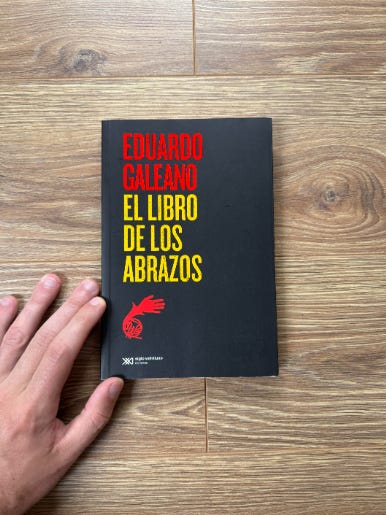
From the beginning, I knew I wanted to read something by Eduardo Galeano. Yet I ended up selecting what was probably his least obvious choice: El Libro de los Abrazos (The Book of Embraces).
Eduardo Galeano and the Memory of a Continent
Eduardo Galeano was born in Uruguay in 1940 and died just over a decade ago, in 2015.
He was one of the country’s most respected journalists, writers, and public intellectuals, associated with the political left.
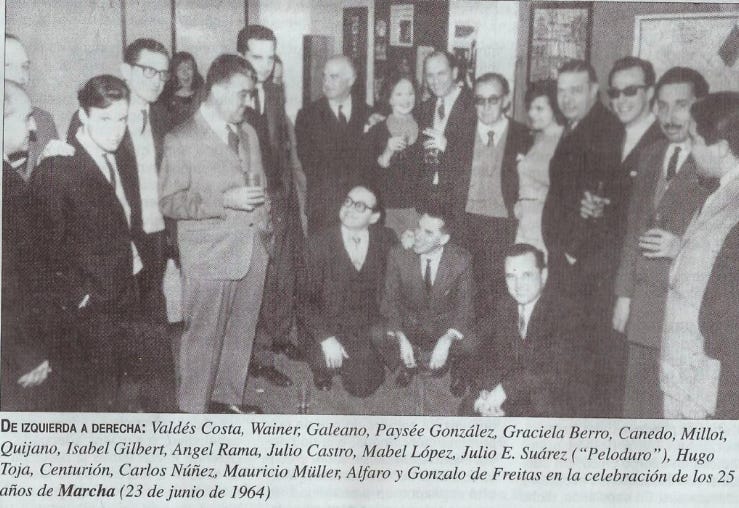
Although he came from one of Uruguay’s more prominent families, opposition to authoritarianism was never foreign to him. Following the military coup of 1973, Galeano was briefly imprisoned and later forced into exile in Argentina.
Over the course of his literary career, he produced several remarkable works, including Open Veins of Latin America—one of the books Isabel Allende reportedly took with her while fleeing Chile after Pinochet seized power—and the trilogy Memory of Fire.
His books combine sweeping historical analysis of Latin America, from European colonization and slavery to wars of independence and modern dictatorships.
In short, there is no shortage of excellent places to start.
Yet while browsing a bookstore in Valencia during a trip to Spain, I stumbled across El Libro de los Abrazos and, on impulse, decided that this would be my Uruguayan book.
Why I Thought I Had Chosen the Wrong Book
Unlike Galeano’s celebrated historical works and political reportage, The Book of Embraces is deeply personal.
It is a collection of brief literary fragments: aphorisms, miniatures, private reflections, humorous observations, and poetic snapshots.
Together they form a collage of memory—a mosaic of Latin American history, culture, and, above all, everyday life.
Through these fragments, Galeano attempts to preserve his own memories while transforming them into the collective memory of an entire continent.
The result is a patchwork of stories about violence and exploitation, absurd anecdotes exposing the follies of power, and ironic reflections on both grand historical events and tiny moments that might otherwise pass unnoticed.
The Walls Speak
Among all these fragments, the passages that stayed with me most were those Galeano collected under the title Dicen las paredes—The Walls Speak.
These were not his own words. They were graffiti.
Anonymous messages he encountered during his travels and decided to preserve.
Urban poetry is often ephemeral. Paint fades. Walls are demolished. Entire neighborhoods disappear. Even though Galeano did not write these messages himself, he became their chronicler.
Few writers, I suspect, would have been able to recognize in these small, often barely visible scribbles the voice of society itself.
That attentiveness reveals just how extraordinary an observer Galeano was. He noticed details that tell us more about Latin America than many multi-volume novels ever could.
Each graffiti fragment is accompanied by only the briefest context: where it appeared and when.
Nothing more is needed.
The Wisdom of the Streets
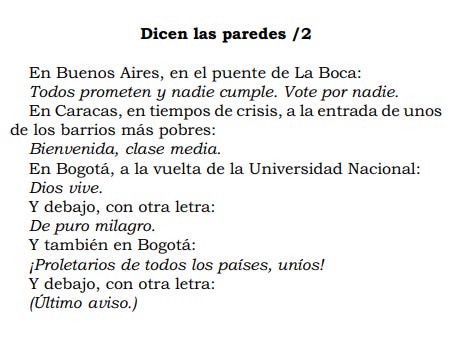
At the entrance to the National University in Bogotá:
“God lives.”
Written below, in a different hand:
“By a miracle.”
Elsewhere in Bogotá:
“Workers of the world, unite.”
Added underneath:
“(Last warning).”
In Caracas, during an economic crisis, at the entrance to one of the city’s poorest neighborhoods:
“Welcome, middle class!”
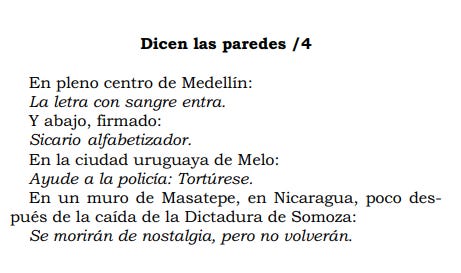
In the Uruguayan town of Melo:
“Help the police—torture yourself!”
At the Faculty of Economics in Montevideo:
“Drugs cause amnesia and other things I can’t remember.”
In Santiago de Chile, along the banks of the Mapocho River:
“Blessed are the drunkards, for they see God twice.”
In the Flores district of Buenos Aires:
“A girl without breasts is less of a girl than she is a buddy.”
Pick up The Book of Embraces if you are looking for Latin American humor, satire, irony, and a unique literary attempt to preserve the memory of a continent.
My rating - 7/10
Further Reading
The Book of Embraces (PDF Edition)
https://www.colegioemaus.edu.ar/assets/el-libro-de-los-abrazos.pdf
Eduardo Galeano – Biography
https://en.wikipedia.org/wiki/Eduardo_Galeano
* Translated from Polish using AI.