
#Project195 - GUATEMALA
The Earthquake That Helped Bring Guatemala a Nobel Prize

Discovering Asturias
While searching for a Guatemalan book to read for Project195, I came across the name of the country’s only Nobel Prize winner in Literature: Miguel Ángel Asturias.
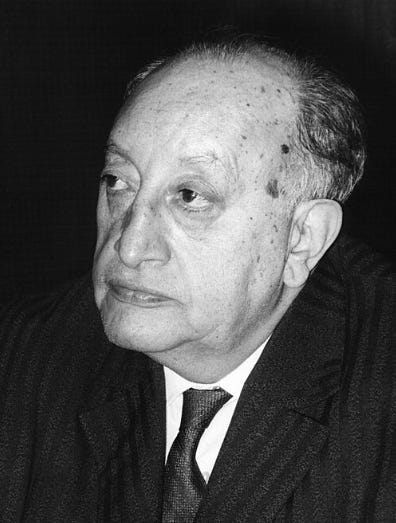
Asturias in 1968
In a 1970 interview with a German literary critic, Asturias was asked what had inspired him to become a writer. His answer immediately caught my attention:
“Yes, at 10:25 pm on the 25th of December in 1917, an earthquake destroyed my city. I saw something like an immense cloud conceal the enormous moon. I had been placed in a cellar, in a hole, in a cave or someplace else. It was then that I wrote my first poem, a song of farewell to Guatemala. Later, I was angered by the circumstances during which the rubble was cleared away and by the social injustice that became so bloodily apparent.”
The Nobel Prize interested me.
The earthquake interested me even more.
At that moment I knew almost nothing about Asturias, his novels, or the disaster he described. I decided to change that.
Choosing El Señor Presidente
I picked one of Asturias’s most celebrated novels, El Señor Presidente (The President), recently republished in a new Polish translation.
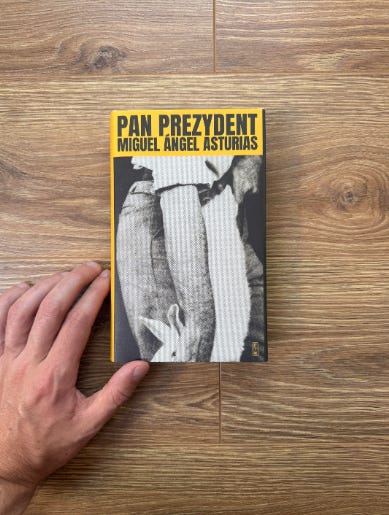
This time I chose to read it in Polish. Asturias combines realism with folklore, Christian and Indigenous symbolism, dream sequences, and elements that would later be associated with magical realism. Combined with his dense, baroque prose, reading him in the original Spanish felt like more of a challenge than I was ready for.
Asturias was a Guatemalan novelist, poet, and diplomat born in 1899. Although he spent much of his life abroad, particularly in France, he became one of the pioneers of what would later be known as the Latin American Boom—the literary movement that introduced Latin American fiction to readers around the world.
In 1967, he was awarded the Nobel Prize in Literature.
A Dictator Who Is Almost Never Seen
Although El Señor Presidente was largely written during the 1920s, it was eventually completed and published in 1946.
The novel tells the story of a fictional dictator clearly inspired by Manuel Estrada Cabrera, who ruled Guatemala from 1898 to 1920.
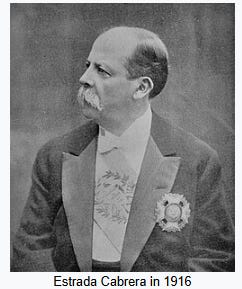
Asturias explores how dictatorship shapes everyday life, social relationships, and personal choices in a society stripped not only of freedom but also of hope.
Curiously, the dictator himself remains largely absent from the narrative.
Yet his presence dominates every page.
His invisible eye watches citizens even during their most intimate moments. Through the experiences of lawyers, soldiers, beggars, politicians, and ordinary residents of the capital, Asturias reveals a system built on surveillance, repression, fear, and arbitrary violence.
The result often feels closer to a political nightmare than a political novel.
Reality, Dreams, and Fear
The novel contains elements of surrealism, grotesque imagery, and what would later evolve into magical realism.
What makes Asturias particularly interesting is that these elements are inseparable from the minds of his characters.
Readers are never entirely sure whether spirits, visions, and supernatural forces actually exist within the story, or whether they emerge from the terrorized consciousness of people living under dictatorship.
The uncertainty itself becomes part of the experience.
Reality has become so distorted that even the characters no longer trust what they see.
Did the Earthquake Really Shape Asturias?
That question stayed with me throughout the novel.
Could a single earthquake truly have stood behind Asturias’s literary imagination?
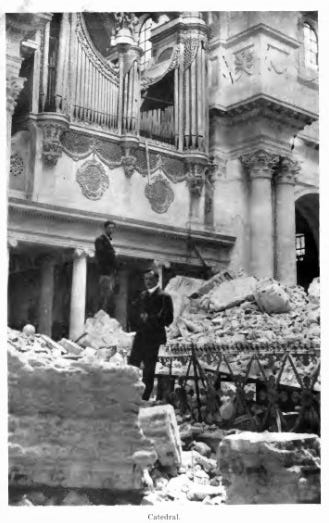
The historical record suggests it may have.
The first tremors began in November 1917, but the most devastating earthquake struck on Christmas night.
Official records describe the main shock as follows:
“December 26 [December 25, 22:20 local time] was the main event with a magnitude of 6 plus and maximum Modified Mercalli intensity of VIII–IX. In Guatemala City, cracks opened in the streets, and about 40 percent of the houses were destroyed or seriously damaged.”
Asturias was eighteen years old.
He witnessed it all.
The Destruction of Guatemala City
One of the most remarkable eyewitnesses was Prince Wilhelm of Sweden and Norway, Duke of Södermanland, who happened to be traveling through Guatemala at the time.
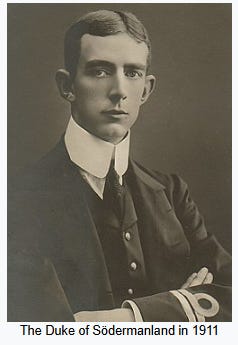
In his 1920 travel memoir Between Two Continents, he described the catastrophe:
“Walls cracked in two, roofs fell in, church towers crashed down, burying adjacent buildings and human beings under the ruins. After a few hours the once well-built city was nothing but a smoking mass of debris.”
More than 2,600 people died.
Over 200,000 were left homeless.
Much of Guatemala City’s historic center was destroyed, including buildings that had survived the previous great earthquake of 1773. Schools, churches, museums, hospitals, railway stations, post offices, and the famous Teatro Colón suffered severe damage or complete collapse.
The city was transformed into ruins.
An Even Darker Horror
Yet one of the most disturbing consequences of the disaster is rarely mentioned.
At the time, many Guatemalans were buried in above-ground masonry tombs.
The earthquake shattered large sections of the city’s cemeteries.
More than 8,000 human remains were reportedly scattered across the ground.
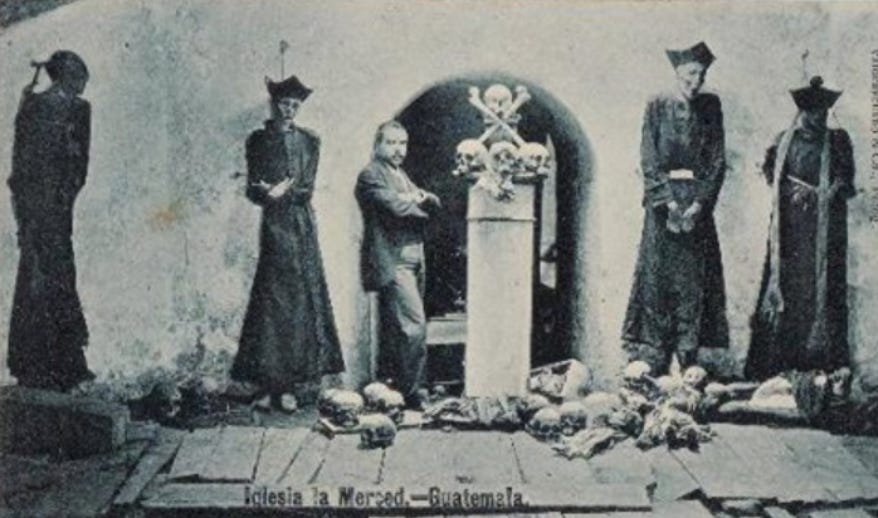
To prevent disease, authorities burned bodies in enormous funeral pyres whose smoke drifted across the city.
The image feels almost biblical in scale.
It is difficult to imagine a young aspiring writer witnessing such scenes without being permanently affected by them.
The Earthquake That Shook a Dictatorship
Historians generally regard the earthquake as one of several events that contributed to the fall of Manuel Estrada Cabrera.
His government responded poorly to the disaster and failed to provide effective leadership during the crisis. The earthquake did not merely bring down buildings. It exposed the weakness and incompetence of the regime itself. Three years later, Cabrera was overthrown.
The dictator who inspired Asturias’s novel lost power.
My rating - 7.5/10
Further Reading:
Official Record of the 1917–1918 Guatemala Earthquakes - https://web.archive.org/web/20180222104838/https://www.ngdc.noaa.gov/nndc/struts/results?eq_0=3101&t=101650&s=13&d=22,26,13,12&nd=display
Between Two Continents: Notes from a Journey in Central America by Prince Wilhelm of Sweden (1920) - https://archive.org/details/journeycentral00wilhrich/mode/2up?q=earthquake
A un siglo de los terremotos del 25 de diciembre de 1917 - youtube.com/watch?v=GfP2ve0l0OM
Pictures of the 1917 earthquake - https://www.alamy.com/stock-photo/guatemala-earthquake-1917.html?blackwhite=1&sortBy=relevant
* Translated from Polish using AI.