
#Project195 - EGYPT
The Writer Who Was Almost Killed for His Books

Although Egypt is a country whose history and culture stretch back several millennia, its modern literary canon can boast only one writer awarded the most prestigious of all literary honors: the Nobel Prize. That writer is Naguib Mahfouz.
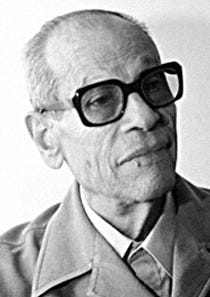
Over the course of his long life - more than ninety-four years - Mahfouz produced an extraordinary body of work: over 35 novels, 350 short stories, 26 screenplays, 7 plays, and hundreds of articles, essays, and journalistic texts published in countless periodicals. To this day, he remains an undisputed icon of modern Arabic literature worldwide.
What far fewer people know, however, is that his writing - so deeply rooted in Egyptian history and social reality - ultimately led to an attempt on his life.
But first, some context.
Project195 and the Choice of Mahfouz
As part of my Project195, I aim to read one book from every country in the world. When choosing a title, it is crucial to me that the book be as significant as possible to the country itself - its culture, history, and readers.
In the case of Egypt, there was nothing to deliberate. I had to choose one of Mahfouz’s many works.
Mahfouz was born in 1911, the youngest of seven children, into the family of a government official in Cairo. At the time, Egypt was a British colony, and British soldiers were a constant presence in the capital’s daily landscape. He grew up in the streets of the old city; only thirteen years after his birth did his family move to the outskirts of Cairo. The climate, smells, sounds, and images of his childhood would echo throughout his novels for the rest of his life and largely define their uniqueness. Autobiographical elements are, in fact, a frequent feature of his most famous works.
Mahfouz’s mother was the daughter of a Cairo sheikh responsible for one of the city’s most important mosques, Al-Azhar. He therefore grew up in a deeply religious - by today’s standards, perhaps even radically religious - household. This background profoundly influenced both his later writing and his perception of the sweeping socio-cultural changes that would soon transform the region. In one interview, Mahfouz famously remarked:
“You would never have thought that an artist would emerge from that family.”
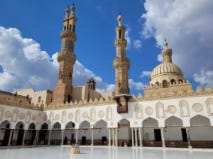
I would add that it is equally astonishing that such an artist could emerge with such a conscious and critical view of religion itself.
To avoid recounting an entire biography - something that would require a book of its own - it is worth mentioning one more formative episode from Mahfouz’s childhood.
When he was just seven years old, in 1919, Egypt erupted into a long-simmering independence revolution that ultimately led to British recognition of Egyptian statehood in 1922. Although Mahfouz was only a child, the sound of gunfire directed at demonstrators on the very streets he walked to school left a permanent mark on his psyche.
Cairo, Religion, Revolution
These three elements - Cairo, religion, and revolution - are clearly present in the first volume of his Cairo Trilogy, which I had the pleasure of reading: The Palace Walk (Bayn al-Qasrayn, 1956).
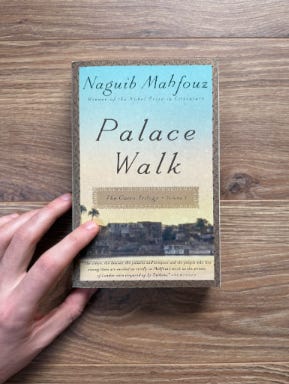
Both the novel itself and the entire trilogy are widely regarded as among the greatest achievements of twentieth-century Egyptian literature. The story unfolds in one of Cairo’s old districts, from the time of the First World War up to the outbreak of the independence revolution. We follow several generations of the Abd al-Jawad family -characters who captivate not only through the literary beauty and realism of their relationships, but also as an allegory of Egypt’s broader social, religious, and political transformations during this period.
Mahfouz’s narrative style - realist yet rich in symbolism and infused with the rhythm of the Arabic language - places him firmly among the giants of world literature. For me, he stands alongside Proust (a personal comparison) and figures such as Tolstoy or Balzac. Walking through Cairo with Ahmad Abd al-Jawad and his family, we do not merely observe a vanished world; we taste local spices, feel the heat of summer air on our skin, and hear the sounds of a chaotic, overcrowded metropolis. His language is fluid, delicate, and lyrical, yet precise and profoundly human. At times, it feels as if we are standing behind the characters, listening to their conversations firsthand. Thanks to Mahfouz’s prose, early-twentieth-century Cairo becomes not just a backdrop, but one of the novel’s central characters.
Islam also plays a crucial role - specifically the way its culture, law, and traditions shape not only the actions of the characters, but their identities and their understanding of themselves and the world. In The Palace Walk, Mahfouz portrays radical generational change: from a patriarchal order in which women are effectively confined to their homes, to a reality where fleeting romances are accepted and even expected as markers of modernity and social confidence. These contrasts highlight how important feminist themes were to Mahfouz, and how acutely aware he was of inequality, injustice, and hypocrisy -particularly striking given his upbringing.
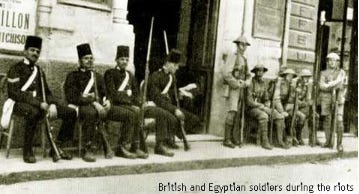
The final pillar of the novel is its placement within the national liberation movement and the independence revolution itself. Throughout the book, Mahfouz weaves motifs of national pride, identity, and the allure of modernity, including its political dimensions. Only in the novel’s closing moments, however, does he fully reveal what it means, in his view, to be Egyptian - and what the true cost of national pride and independence is when measured against the barrel of a rifle.
From Literature to Violence
I write all this not merely to encourage reading Mahfouz - his literary value is beyond dispute - but to sketch a portrait of an artist whose worldview was embedded in his fiction. That portrait proved so controversial that it eventually led to an attempt on his life.
In 1988, the world encountered another controversial literary work: Salman Rushdie’s The Satanic Verses. Inspired in part by the life of the Prophet Muhammad, the novel was acclaimed by critics and shortlisted for the Booker Prize, yet it simultaneously provoked a wave of hatred from radical Islamist groups.
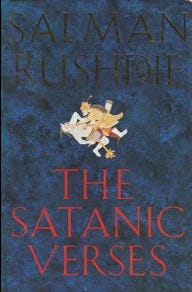
After Iran’s supreme leader Ruhollah Khomeini issued a death fatwa against Rushdie in 1989, the writer became a prime target for Islamist extremists worldwide. His books were burned, protests erupted across Muslim-majority countries, and in 1991 his Japanese translator Hitoshi Igarashi was murdered. Rushdie himself survived multiple assassination attempts, including the 2022 attack - more than thirty years after the novel’s publication - that left him blind in one eye and paralyzed in one hand.
One of the indirect victims of this wave of hatred was Naguib Mahfouz.
Children of Gebelawi and the Fatwa
As early as 1959, Mahfouz had published another major novel, Children of Gebelawi (Children of the Alley). The book tells the story of the three Abrahamic religions - Judaism, Christianity, and Islam - through an allegory set in a nineteenth-century Cairo alley.
Originally published in serialized form, the novel immediately drew fierce criticism from religious circles. After intervention by then-president Gamal Abdel Nasser, its publication as a book was halted in Egypt. Lebanon was the only Muslim-majority country to publish the novel, which it did in 1967.
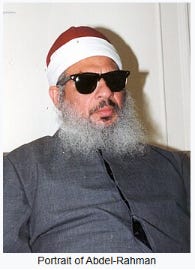
In 1989, the book became the basis for a formal condemnation by Omar Abdel Rahman, known as the “Blind Sheikh”, a radical cleric associated with the terrorist organization Al-Gama’a al-Islamiyya (later responsible, among other acts, for the 1997 Luxor massacre in which nearly sixty people were killed).
During the Rushdie controversy, Rahman remarked:
“If this sentence had been passed on Naguib Mahfouz when he wrote Children of the Alley*, Salman Rushdie would have realized that he had to stay within bounds.”*
The Attempt on Mahfouz’s Life
The consequences were grim. In 1994 - almost exactly one year after receiving the Nobel Prize from the Swedish Academy - Mahfouz was attacked by two assailants outside his home in Cairo. He was stabbed in the neck and narrowly escaped death. Although he survived, the injuries and subsequent complications prevented him from writing and living normally for the rest of his life. He died in 2006.
Four months after his death, Children of Gebelawi was finally published in Egypt. It immediately became a bestseller.
My Rating: 8,5/10
Further Reading
Palace of Desire (1957) - Cairo Trilogy, Part II
Sugar Street (1957) - Cairo Trilogy, Part III
Children of Gebelawi (1959)
What the Stabbing of a Nobel Prize–Winning Novelist Tells Us About Power in Egypt