
#Project195 - COLOMBIA
Reading in Another Language Pays Off—Twice

As part of Project195, I read one book from every country in the world. When my finger - after a brief flight over a miniature globe bought for a few złoty at a local Pepco - finally landed on its surface, it stopped on Colombia.
Naturally, Colombia’s most obvious literary choice would be Gabriel García Márquez, a national treasure and a global icon. But when I began this project, I promised myself that I would prioritize new discoveries. I already knew Márquez’s bibliography almost in full and had covered his novels and reportage multiple times across my social media channels.
I could, of course, have chosen Álvaro Mutis, Jorge Isaacs, José Eustasio Rivera, or Juan Gabriel Vásquez - names readily suggested by search engines and increasingly sophisticated language models. Instead, I decided to step slightly outside my usual pattern and pick a book that was less canonical, but potentially more approachable to read in the original Spanish.
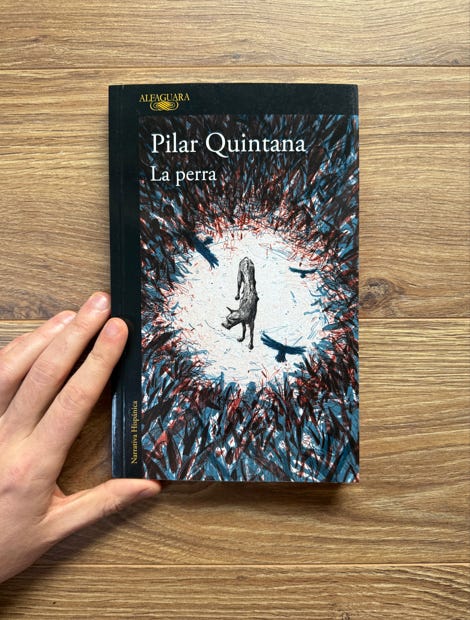
That is how I arrived at La perra (The Bitch, 2017) by Colombian writer Pilar Quintana.
Why La perra?
The choice was not obvious. Quintana is a well-recognized Colombian author, translated into several languages, yet she stands apart from many Colombian classics steeped in Latin American magical realism.
More importantly for me, I learned that her language is simpler, her style more restrained, and the book itself relatively short. These were decisive factors, because I set myself a second challenge alongside this reading: I wanted to read the novel entirely in Spanish, using it as a way to actively practice the language.
I am not writing this to showcase my linguistic skills (perhaps just a little), but primarily to highlight how reading a novel in its original language fundamentally changed my perception of literature - and opened several new doors.
I had read books in English before, and even one or two in Spanish. But I always treated that experience either as an obstacle to overcome in order to reach the content, or as a language-learning exercise focused on vocabulary and comprehension. Rarely was it pure pleasure.
La perra was different.
Reading Without the Translator’s Filter
From the very beginning, I felt confident in my ability to understand the Spanish text. That freed me to focus exclusively on the reading experience itself - on enjoyment, rhythm, tone, and proximity to the source. For years, I had grown so accustomed to reading in Polish that I never truly considered how translation itself shapes our experience of a book.

As I immersed myself in Quintana’s short novel, an initial wave of anxiety set in. Had I overestimated my skills? Would I need to translate every other word? Would I lose more than I gained? The fear faded quickly. Words began to fall into place. Unknown expressions found temporary mental shelves, waiting for meaning to emerge through context or memory. After a few pages - perhaps a dozen - I was no longer decoding. I was reading.
A Quiet Novel That Turns Dark
La perra is an intense novel. Short enough to be called a novella, it initially appears calm, even subdued. With each page, however, it gathers momentum and psychological depth.
We follow Damaris, a middle-aged woman who adopts a puppy in an attempt to fill the aching void left by her unfulfilled desire for motherhood. Over time, the seemingly innocent bond between woman and dog grows heavier, darker. What begins as care slowly turns into obsession - an obsession that can only end in tragedy.
To say more would ruin the effect Quintana carefully builds.
What matters is that she succeeds in crafting a narrative that is both intimate and devastating, without excess or spectacle.
Pilar Quintana Beyond Magical Realism
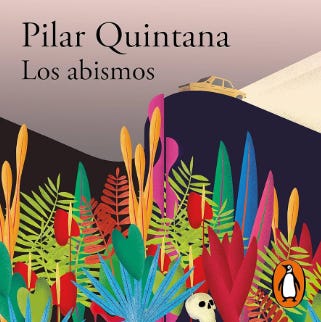
Quintana is an increasingly important voice not only in Colombian literature, but also beyond Spanish-speaking markets. In 2021, she won the prestigious Premio Alfaguara for her novel Los abismos.
Her writing blends everyday life on the margins with the raw force of nature - both internal and external. In La perra, nature is not merely represented by the animal itself. The dense forest, the powerful ocean waves, the oppressive Colombian heat—these elements are not background scenery. They are integral to the story, shaping the characters and resonating directly with the reader.
What sets Quintana apart most clearly is her deliberate move away from magical realism. Instead of spirits, myths, and fantastical imagery, she offers brutal realism - physical, psychological, and emotional. La perra is a stark exploration of womanhood, motherhood, loneliness, frustration, and desire. The dog becomes a mirror for Damaris: an embodiment of her fears, longings, and suppressed impulses. Their relationship forms the novel’s emotional core and defines its unsettling power.
The Double Reward of Reading in the Original
I return, finally, to where I began.
Quintana’s simple, restrained, and unsentimental prose allowed me to benefit twice. First, it made reading in the original language genuinely possible - and enjoyable. Second, it delivered exactly what I value most as a reader: mounting tension and emotional weight, achieved not through ornamentation, but through precision and honesty.
More importantly, this experience taught me something I felt already while still reading: a novel read in its original language is, by nature, more honest. It brings us closer to the author’s intentions and emotions. It removes - however talented - the intermediary of the translator, who inevitably interprets. Language itself, when changed, imposes its own limitations and distances us further from the source.
La perra inspired me to reach for originals more often. Sometimes that choice is more expensive, requiring international orders. Sometimes it demands patience. But now I know it is always more rewarding.
My rating: 6.5/10
Further reading
Pilar Quintana, Los abismos. Alfaguara, 2021
Pilar Quintana, Noche negra. Alfaguara, 2025
La colombiana Pilar Quintana gana el Premio Alfaguara con una novela de relaciones familiares
* The text was translated from Polish using AI.