
#Project195 - BELGIUM
How do you write 500 novels and sleep with 10,000 women?

For some time now, voices have been growing louder in book media: quality over quantity. We should not compete in the number of books we read. We should not give in to the trend of annual summaries and rankings.
“I read 130 books this year, here are my top 3.”
One good book a month, read carefully, analyzed, and thought through, is supposed to bring more value than fifty books skimmed and shelved.
So how should we think about writers who have produced 500 novels or more?
Between scarcity and excess
In my Project195, I read one book from every country in the world. The goal is simple: to expand reading horizons, to encounter unfamiliar contexts, histories, and perspectives, to reach for books I would never normally pick up in a bookstore.
Sometimes the problem is scarcity. In the case of Liechtenstein, for example, there is essentially a single book translated into a language I can read.
Other times, the problem is the opposite: an overwhelming abundance. Belgium belongs to that category.
Instead of reaching for canonical national novels from the turn of the nineteenth and twentieth centuries, I chose something lighter. Not only to avoid spending an entire month on a single book, but also because Belgium is home to a writer known and appreciated by hundreds of thousands of readers, the creator of one of the most important crime series in literary history.
Georges Simenon.
A writer beyond categories
Simenon, born in 1903 in Liège, is a figure that borders on myth. Over the course of his career, he achieved two things that continue to define his legend: he wrote over 500 novels, and he claimed to have slept with more than 10,000 women.
Before focusing on the sensational, it is worth looking at his craft.

Simenon forces us to ask two separate questions. First: what kind of daily routine allows someone to produce more than sixty pages a day? Second: how does that output avoid becoming mere pulp fiction?
Literary history, if we can still use that term without quotation marks, is full of hyperproductive authors. Many of them are labeled as writers of pulp fiction, commercial literature built for speed, repetition, and sales. Stories constructed from templates, reshuffled endlessly with minor variations.
Examples are easy to find.
Ryoki Inoue, with over 1,100 books across romance, western, and horror.
Barbara Cartland, with more than 700 historical romances.
Corín Tellado, with over 4,000 works centered on love stories.

They achieved immense commercial success, yet rarely entered the literary canon. Today, we might be more inclined to see them as content producers rather than writers.
And yet there are exceptions.
The exception: Simenon
One such exception is Isaac Asimov, a central figure of science fiction, whose output exceeded 500 books across genres.
Simenon belongs, I would argue, in that same category of exceptions.
He is widely regarded as one of the great crime writers of the first half of the twentieth century, often placed alongside Agatha Christie and Raymond Chandler. His work, unlike most pulp fiction, carries genuine literary weight.
Writing primarily in the noir tradition, Simenon shifted the focus from private detectives to state authority. His most famous character, Inspector Maigret, is not an outsider but a representative of the system.

Through this shift, Simenon offered more than mystery plots. He provided a portrait of Belgian and French society, a glimpse into the workings of the police, and a reflection on the role of the state in confronting crime.
His influence on later European and American crime writers is difficult to overstate.
Discipline as method
How, then, did he sustain both quantity and quality?
Simenon approached writing with near-obsessive discipline.
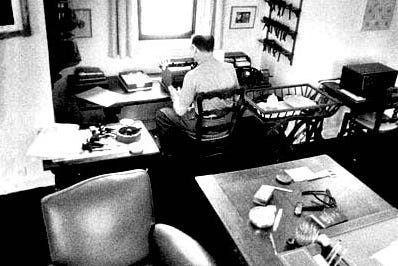
He prepared his workspace meticulously, whether in one of the more than thirty homes he lived in across different countries. An IBM typewriter. Telephone directories used as sources for names and addresses. Pipes and tobacco, ever-present in photographs.
He selected names in advance, wrote them down on his characteristic yellow sheets of paper, and only the next day began writing.
The plot, he claimed, arrived naturally. He never planned it in advance. He searched first for the right names, for sounds that felt true both spoken and written.
Each morning, he would isolate himself, hang a “Do not disturb” sign on the door, and write relentlessly. No revisions. No corrections. Up to ninety words per minute. A novel could take anywhere from a few days to a month.
At times, he would write an entire book wearing the same shirt, freshly washed and pressed each day, waiting for him in the morning.
He described his method simply:
“It is almost a geometrical problem. I have such a man, such a woman, in such surroundings. What can happen to them to oblige them to go to their limit?”
Sketches and mosaics
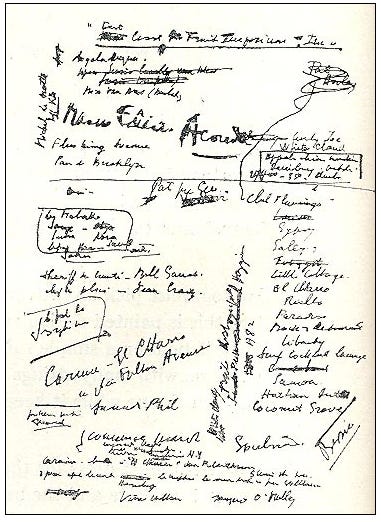
Interestingly, Simenon saw his detective novels as sketches, something like quick drawings made for friends.
His true artistic ambitions, he claimed, were realized in longer, more psychological novels such as Red Lights, The Death of Belle, or The Clockmaker of Everton, written during his years in the United States.
And yet, taken together, his entire body of work forms something larger.
“I will never write a big novel. My big novel is the mosaic of all my small novels.”
The man and the myth
And what of the famous 10,000 women?

Simenon once said:
“I literally suffered from knowing there were millions of women in the world that I would never know.”
Much of this was likely exaggeration, though a significant number of his relationships involved sex workers. His private life, marked by infidelity tolerated by his wives and partners, would today likely be interpreted differently.
Still, it contributed to the myth of a writer defined by excess, both in life and in work.
A small piece of a larger whole
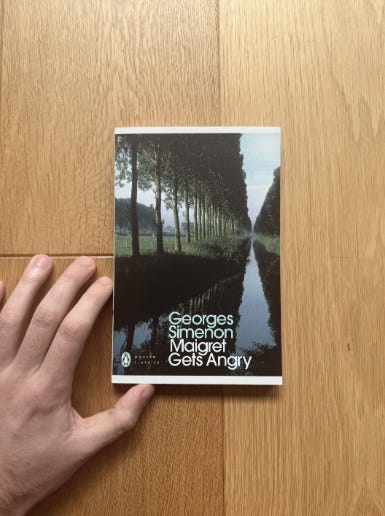
The novel I read for Belgium was Maigret Gets Angry. In many ways, an ordinary crime novel.
But it is difficult to judge it in isolation. It feels more like a fragment of something much larger, part of a vast literary system built over decades.
My rating - 5.5 / 10
Further reading:
Georges Simenon bibliography
https://www.fantasticfiction.com/s/georges-simenon/Interview with Georges Simenon, The Paris Review, 1955
https://www.trussel.com/maig/parisrev.htm
* Transalted from Polish using AI