
#Project195 - BELARUS
How Do You Write a Horror Novel Without Writing Horror?

One Sunday afternoon in Kraków, I went for a short walk around the Main Market Square.
Hundreds of excited tourists surrounded me. Plastic advertising boards littered the sidewalks, inviting every passerby to stop for a traditional Polish lunch. Church bells echoed across the city center.

As I was about to head home, I noticed something I had somehow missed despite walking that street hundreds—perhaps thousands—of times before.
Hidden in the courtyard of one of the old townhouses was a tiny second-hand bookstore.
A modest glass display case was attached to the building’s façade. Inside sat several dusty academic volumes, most of them roughly a century old, alongside a small sign directing visitors deeper into the passageway.
I gave in to temptation and stepped inside.
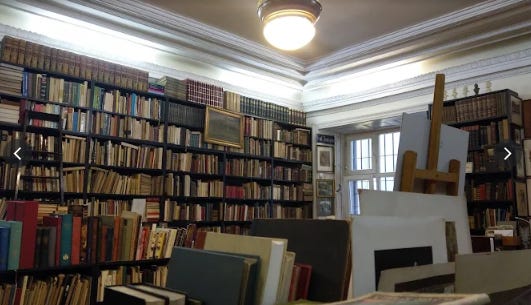
The unmistakable smell of old paper, dust, and hardcovers handled by generations of readers immediately filled the air.
A Perfect Discovery
I rarely buy books from second-hand bookstores.
I am a perfectionist. I like clean pages, simple covers, and well-preserved copies.
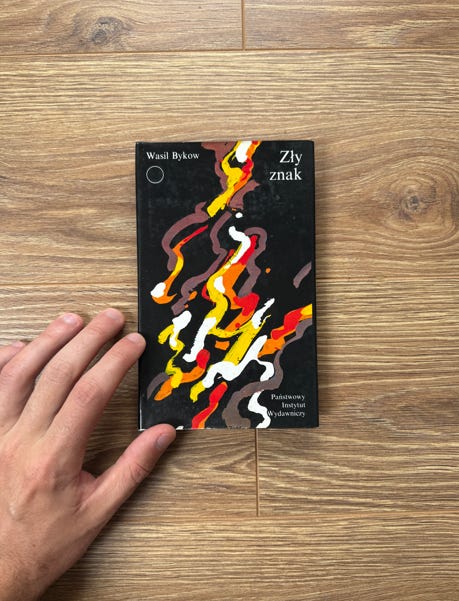
Yet on one shelf I found a neatly stacked collection of small books wrapped in black dust jackets. Most were in remarkably good condition. Each belonged to a series published by the Polish State Publishing Institute in the early 1990s called World Prose.
Could there have been a better hunting ground for Project195?
Perhaps Amazon.
But here I could actually hold each book in my hands, study its cover, leaf through its pages, and decide whether it deserved a place in the project.
One of them was perfect.
It was The Sign of Misfortune by Vasil Bykaŭ.
A Writer Who Knew War Firsthand
I do not know whether one must be a soldier to write convincingly about war.
Vasil Bykaŭ was one, and he wrote about war better than almost anyone.
Born in a small village in what is now Belarus in 1924, Bykaŭ remains one of the most celebrated Belarusian writers, notable not only for writing in Russian but also in Belarusian.
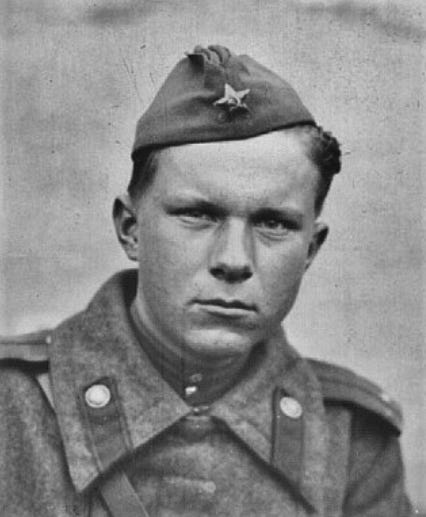
Until his death in 2003, he worked as a writer, translator, intellectual, and, for a time, a political figure.
Most importantly, however, he was also a veteran.
At just seventeen years old, he joined the Red Army after Nazi Germany invaded the Soviet Union in 1941. Belarus was then part of the Soviet state, and the experiences he gained during the war would shape the rest of his literary career.
Most of his work focused on the German-Soviet conflict during the Second World War—the conflict known in the former Soviet Union as the Great Patriotic War.
Unlike many war writers who approached conflict through absurdism, satire, or existential reflection—authors such as Kurt Vonnegut, Joseph Heller, or Aleksandr Solzhenitsyn—Bykaŭ relied on uncompromising realism.
The Invisible People of History
In the novel I discovered in that Kraków bookstore, Bykaŭ avoids heroism, grand speeches, and larger-than-life characters.
His protagonists are not merely ordinary people.
They are people almost invisible to history itself.
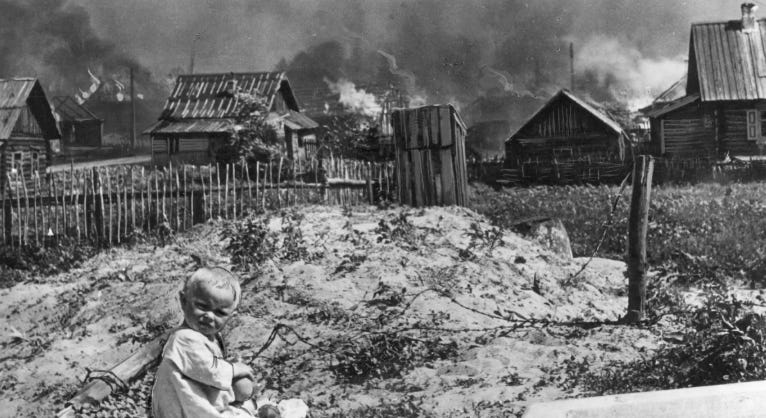
While many war novels focus on decisive battles or political leaders shaping the course of nations, The Sign of Misfortune centers on an elderly farming couple living in a crumbling cottage at the edge of nowhere.
Unfortunately for them, Bykaŭ’s edge of nowhere happens to lie directly on the path of German troops moving eastward toward the front.
So Why Call It Horror?
A horror novel is supposed to disturb, terrify, and frighten its reader.
Today, the genre is associated with classics such as Frankenstein and Dracula, or with modern bestsellers by Stephen King and Thomas Harris.
What does any of that have to do with a Belarusian novel about peasant life during the Second World War?
The answer is simple.
I cannot remember the last time a book frightened me this much.
I was not afraid of monsters under the bed.
I was not afraid of supernatural creatures or serial killers.
I was afraid of violence.
I was afraid of humiliation.
I was afraid of death.
Most of all, I was afraid for the people in this book.
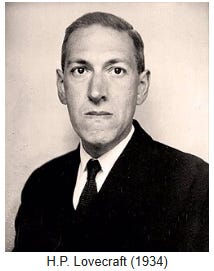
As H. P. Lovecraft once wrote:
“The oldest and strongest emotion of mankind is fear, and the oldest and strongest kind of fear is fear of the unknown.”
The unknown is precisely what makes Bykaŭ’s fiction so terrifying.
Will a German soldier harm us?
Will a distant relative betray us?
Will the occupiers discover the last food we have hidden away for emergencies?
Will a passing soldier’s momentary whim end with the death of the animal we love?
Will we survive until tomorrow?
These are the questions we ask on behalf of the novel’s characters, sparing them the need to voice their fears aloud.
On the surface, The Sign of Misfortune is a simple story about a forgotten Belarusian village where life follows the rhythms of nature.
But at a certain point it transforms into one of the most frightening books I have ever read.
It becomes horror.
Read Vasil Bykaŭ if you want to learn not only what happened in Belarus during the Second World War, but also what it felt like to live there at that moment in history.
My rating - 9/10
* Translated from Polish using AI.