
#Project195 - AUSTRALIA
What Happened to Ludwig Leichhardt?

On 3 April 1848, a group of seven men set out from the estate of Allan Macpherson, one of the last outposts of European civilisation in this part of the continent, heading deep into the Australian interior. The party consisted of two Aboriginal men known locally as Wommai and Billy Bombat, and five Europeans. Leading the caravan - accompanied by more than twenty mules and fifty head of cattle - was Ludwig Leichhardt.
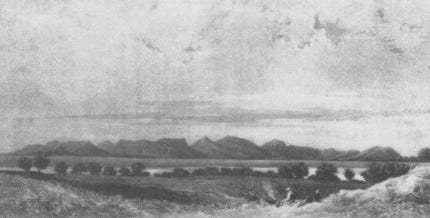
That day was the last time the expedition was ever seen. Nearly 180 years later, their disappearance remains one of the great unresolved mysteries of Australian history.
From Prussia to the Edge of the Known World
Leichhardt was born thirty-five years earlier in the small Prussian village of Tauche, today located in Brandenburg, Germany, not far from the Polish border. One of eight children of a German farmer and royal inspector, he received a solid early education and went on to study philosophy, languages, and biology at the universities of Göttingen and Berlin. He never formally completed his studies.
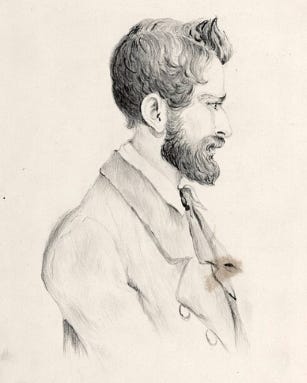
Instead, he moved first to London, where he continued his education at the British Museum, and later to Paris. Academic life, however, was not his ultimate calling. Leichhardt was drawn to something far more profound, unknown, and mysterious: the Australian interior, at the time one of the last great blank spaces on the map of the world.
First Success in the North
His adventure with exploration began relatively modestly. After arriving in Australia, Leichhardt conducted geological, botanical, and zoological research in Queensland, in the northeast of the continent. It soon became clear that this was not enough for him.
He decided to push further north and independently organised his first expedition - a journey that turned out to be a major success and brought him significant recognition upon his return to Sydney.
Leichhardt later described this expedition in his book - Journal of an Overland Expedition in Australia.
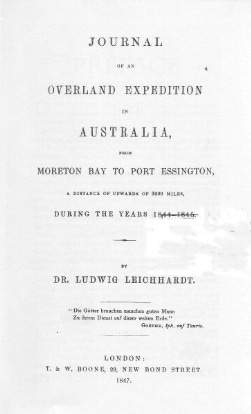
The work is a meticulous travel diary, in which he recorded every detail he deemed important. He did so not only with scientific precision, but often with striking lyricism.
One such entry, dated 3 November 1844, reads:
“Nov. 3.—For the past week, the heat was very oppressive during the day, whilst, at night, it was often exceedingly cold; for two or three hours before dawn, and for an hour after sunset, it was generally delightful, particularly within the influence of a cheerful cypress-pine fire, which perfumes the air with the sweet scent of the burning resin.”
Failure, Conflict, and Collapse
The success and fame of his first expedition enabled Leichhardt to organise another one just a year later, in 1846. This time, with financial support from the government and private donors, a new group under his command set out from Queensland with the goal of crossing the continent to the western coast.
This expedition, however, ended very differently.
After covering less than 800 kilometres, the group was forced to turn back. Torrential rains, malaria, and hunger plagued the expedition and eventually led to open dissent within the ranks. Some members accused Leichhardt of recklessness and poor preparation, claiming he had failed to bring essential medical supplies. Leichhardt, in turn, blamed his companions, accusing them of cowardice and weakness.
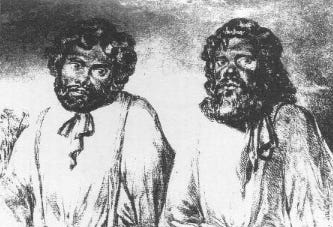
Later materials published by his deputy suggest that Leichhardt may have suffered a nervous breakdown during the expedition, with leadership temporarily taken over by one of the Aboriginal guides.
The Final Expedition
Despite these conflicts and failures, Leichhardt did not abandon his greatest ambition: to explore the inaccessible heart of Australia. While engaged in other research, he simultaneously prepared what would become his final expedition into the interior.
In April 1848, Allan Macpherson - local politician and Scottish-born pastor - said goodbye to the group for the last time. Once again, Leichhardt departed from Queensland, heading west. A small party, accompanied by pack animals, supplies, and scientific instruments, began its march into the unknown.
We will never know how this expedition ended.
The journey was expected to last two to three years, yet no word was ever received from Leichhardt or any of his companions. Four years later, the government of New South Wales organised a search expedition. Apart from a few old campfires and markings carved into trees - “L” and “XVA” - no conclusive evidence was found.
Subsequent search parties discovered additional trees bearing the letter “L”, but none of these clues led to the fate of the expedition or its members. What “L” stands for? Ludwig? Leichhardt? We will probably never know.
Rumours, Traces, and Unanswered Questions
In the decades that followed, several further expeditions attempted to uncover the truth. The results were limited to rumours and circumstantial evidence suggesting that the group may have been attacked and killed by local Aboriginal people. Fragments of objects allegedly belonging to the expedition were reportedly found among nearby tribes, though their authenticity remains disputed.
From History to Literature
Why revisit the story of Leichhardt and his mysterious disappearance?
Because it became the inspiration for one of the greatest novels in Australian literature.
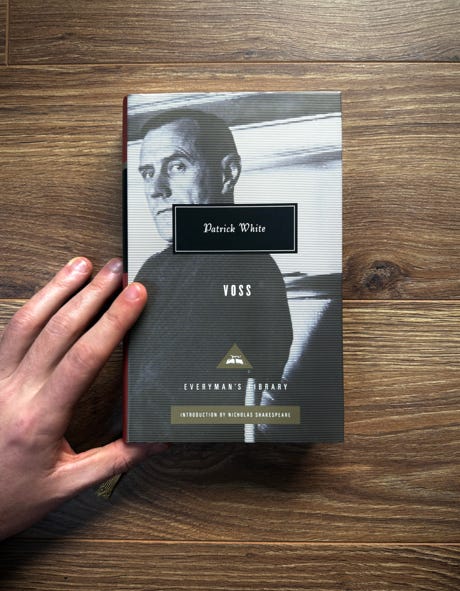
The book is Voss (1957) by Australian Nobel laureate Patrick White. In this monumental novel - widely regarded as one of the country’s greatest, though today somewhat forgotten, literary achievements - White tells the story of a German explorer named Johann Ulrich Voss. The plot and characters are loosely based on the real life of Ludwig Leichhardt.
White transforms historical fact into fiction, creating an extraordinary meditation on loneliness, love, and metaphysics.
Love, Faith, and the Interior of the Soul
Alongside the mysterious expedition into the interior, the novel develops a platonic bond between Voss and Laura Trevelyan, a woman from Sydney whom he meets before the journey. White intertwines the brutal drama of exploration with the spiritual journey of two people separated by hundreds of kilometres of desert, yet connected by a metaphysical bond known only to them.
What fascinates some readers and alienates others is the novel’s pervasive religious symbolism. Voss is compared, at various moments, to God, Christ, and the Devil. His relationship with Laura echoes the biblical story of Adam and Eve in the Garden of Eden.
Equally striking is the novel’s relentless use of contrast and dualism:
the proud, solitary, self-assured man destined for suffering and failure versus the rational woman rooted in society and convention;
desert versus city;
nature versus culture;
faith versus reason;
Indigenous peoples versus colonisers;
explorers versus Aboriginal guides;
criminals versus scientists.
These oppositions operate on multiple levels, inviting interpretation from historical, psychological, spiritual, and cultural perspectives.
An Alternative Ending to a Real Mystery
At its core, Voss is a metaphysical novel. Voss’s journey is simultaneously a descent into his own psyche - a voyage into faith, doubt, and the unknown. Through lyrical descriptions of the Australian landscape and poetic explorations of the human interior, White attempts to reach the absolute. Many would argue that he succeeds as few other twentieth-century writers have.
At the same time, White offers something equally compelling: an alternative version of Leichhardt’s journey. Where history provides silence and mystery, literature offers meaning. White imagines what might have happened after the explorers lost sight of civilisation and entered the unknown.
In this sense, Voss becomes an integral part of Australian cultural memory - just as much as the true story of Ludwig Leichhardt and his ill-fated expedition into the desert interior.
My Rating: 7/10
Further Reading
Ludwig Leichhardt, Journal of an Overland Expedition in Australia
https://www.gutenberg.org/cache/epub/5005/pg5005-images.htmlLudwig Leichhardt Biography: https://adb.anu.edu.au/biography/leichhardt-ludwig-2347
* The text was translated from Polish using AI.