
#Project195 - ARGENTINA
Why I May Have Chosen the Wrong Book

A Bookshop in Valencia
During a week-long trip to Valencia, I bought several books from one of the city’s chain bookstores.

Those purchases are always a highlight for me. Not only can I discover local bestsellers completely unknown outside Spain, but I can also browse Spanish-language books from across Latin America without having to spend hours searching through online bookstores.
On this trip, I picked up a short book by Julio Cortázar: Historias de cronopios y de famas, originally published in 1962.
At first glance, it seemed like a perfect fit for Project195. A completely new reading experience from one of Argentina’s most celebrated writers and intellectuals.
The Life of Julio Cortázar
Julio Cortázar was born in Belgium in 1914 to Argentine diplomats. Because he entered the world almost at the epicenter of the First World War—less than a month after it began—his family fled the German occupation, first to Switzerland and later back to Argentina after the war.

Argentine writer Julio Cortázar, photographed at the UNESCO gardens in Paris.
Sara Facio - Buenos Aires, Buenos Aires, by Alicia D’Amico, Sara Facio & Julio Cortázar - Editorial Sudamericana, Buenos Aires (1968)
Abandoned by his father at the age of six, Cortázar grew up with his mother near Buenos Aires. He became a teacher and studied philosophy, although he never completed his degree. His professional life revolved around translating from French and teaching French literature.
Under Juan Perón’s government, his work became politically unwelcome, prompting him to emigrate to France in 1951. There, he wrote his most famous books and established the literary reputation that would eventually make him one of the central figures of twentieth-century Latin American literature.
Although he occasionally returned to Argentina, he remained closely connected to France for the rest of his life and was buried in Paris after his death in 1984.
For Project195, I could hardly have chosen a more interesting literary figure.
I may, however, have chosen the wrong book.
Or perhaps surrealism simply isn’t a genre I will ever truly love.
Avoiding the Obvious Choice
Cortázar is best known for Hopscotch (Rayuela), one of the most influential and experimental novels of the twentieth century.
I wanted to avoid the obvious choice, however, and instead reached for the much shorter Historias de cronopios y de famas.
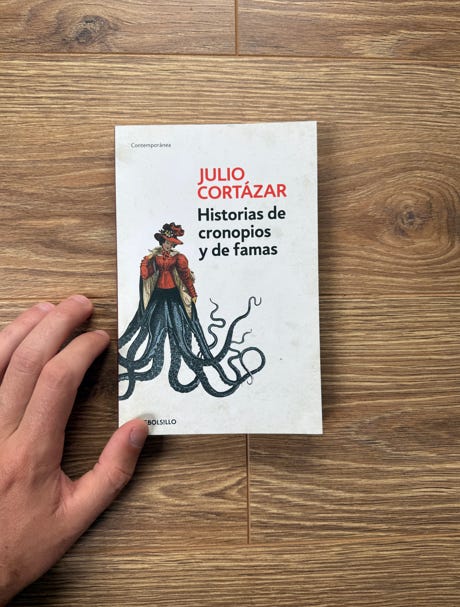
The book is a collection of extremely short, often poetic pieces in which Cortázar dismantles everyday reality and rebuilds it through absurd and surreal perspectives.
Four Different Ways of Looking at Reality
The book consists of four distinct sections.
1. Manual de Instrucciones
The first section, Manual de Instrucciones (”Instruction Manual”), focuses on ordinary activities most of us consider too obvious to think about.
Climbing stairs, for example.
Cortázar describes such actions with elegance, mystery, irony, and humor. By elevating mundane routines to the level of literary subjects, he challenges readers to reconsider how they perceive reality itself.
2. Ocupaciones raras
The second section contains slightly more narrative stories centered around trivial events that become absurdly important.
One memorable example involves an elaborate attempt to identify the owner of a single strand of hair washed down a bathroom sink.
3. Material plástico
The third section broadens its scope and explores larger ideas through surreal premises.
In one piece, so many books are produced that entire oceans become clogged with them, preventing ships from moving across the water.
4. Historias de cronopios y de famas
The final and most famous section introduces three fictional categories of beings: Cronopios, Famas, and Esperanzas.
These function as allegories for different personality types.
The Cronopios are artistic, idealistic, and unconventional dreamers.
The Famas represent the respectable, organized, self-important bourgeoisie.
The Esperanzas occupy the passive middle ground between the two—comfortable, indifferent, and resistant to change.
A Gateway into Literary Experimentation
Together, these four sections provide an excellent introduction to Cortázar’s experimental literary style.
The book is less concerned with plot than with perspective. Its purpose is not to tell stories in the conventional sense but to force readers to see familiar things in unfamiliar ways.
That approach made Cortázar one of the leading figures of the Latin American Boom.

Cortázar and the Latin American Boom
During the 1960s and 1970s, a generation of writers including Gabriel García Márquez, Mario Vargas Llosa, and Carlos Fuentes transformed world literature.
They broke with literary traditions, experimented with narrative forms, and brought Latin American fiction to audiences far beyond their home countries.
Cortázar occupied a particularly distinctive position within this movement because of his fascination with surrealism, absurdity, and playful experimentation.
Why the Book Didn’t Fully Work for Me
And that is probably where my personal difficulty begins.
I can appreciate Cortázar’s humor, irony, originality, and imaginative approach to reality. I understand why his work is admired and why so many writers consider him a master.
What I struggle with is emotional immersion.
I never lose myself in these stories.
I never fall completely under their spell.
At least for now, I find Cortázar more interesting than moving—more intellectually stimulating than emotionally compelling.
That may change in the future.
For the moment, however, I see Historias de cronopios y de famas primarily as a fascinating literary curiosity and an enjoyable break from the kinds of novels I usually read.
I remain a great admirer of the Latin American Boom.
I just don’t think Cortázar will become my favorite representative of it.
My rating - 4/10
Further Reading
An analysis of Cortázar’s use of irony and everyday life - https://www.escritores.org/recursos-para-escritores/recursos-1/colaboraciones/4074-historias-de-cronopios-y-de-famas-de-la-ironia-a-la-cotidianidad
Julio Cortázar - https://es.wikipedia.org/wiki/Julio_Cort%C3%A1zar
The Latin American Boom - https://en.wikipedia.org/wiki/Latin_American_Boom
* Translated from Polish using AI